The game Caves of Qud has devoured hours upon hours of my time recently. It’s an old-school dungeon-crawling roguelike inspired by games like NetHack and Angband, games I had never heard of from a genre I had never touched before trying Qud a few years ago. I had heard of some of its contemporaries: Tales of Maj’Eyal, Cogmind, and CDDA. But they never piqued my interest like Qud.
Qud offers an intensely strange and interesting world, practically begging players to explore it. This world, and the secrets it promised, is what got me to finally try out the genre, got me to stick with the game despite the half dozen immediate deaths. Even now, after I get killed before even realizing I’m in danger, losing a 20 hour run in an instant, the promise of new secrets brings me back. The world really is that compelling.

However, as I play this game more, see more of what the story has to offer, I’ve begun noticing a deep flaw in the game. This game pitches itself as one where the player can be a thousand different people, and have each of those people live a wildly different adventure. This is true in a sense: in one game the player could be a psychic mind-eater, in another they could cover themself head-to-toe in symbiotic fungus, or they could transform themself into a giant slug.
However, it still feels like the player does fundamentally the same thing every game, and it took me a while to figure out exactly how to articulate that. The game feels like it takes place on two planes: “the world” and “the sandbox”, and it unfortunately rarely feels like they intersect. “The world” is where the narrative resides: this is the Qud you read about in books, you hear about from NPCs, and the one you interact with throughout the main questline.
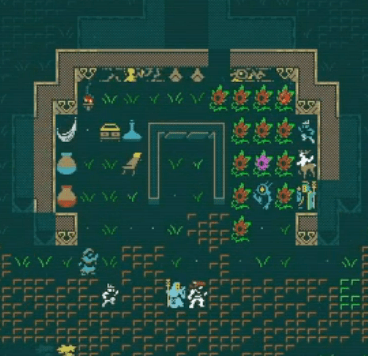
(screenshot from Big Simple on Youtube)
The main questline is certainly commendable. It hosts some of my all time favorite moments in gaming, in fact. You can come face to face with wonders that have been written about as if they were myths, slay ancient demons whose names were whispered in hushed tones in the first village in the game. The game delivers truly spectacular moments when you’re actually allowed to interact with the world it’s told you so much about. And characters remember what you do! The Barathrumites, the main questgiving faction, will actually discuss your actions in the main questline. The first time I had returned from the Tomb of the Eaters and they excitedly asked what it had been like inside, I was ecstatic.
However, after the fifth late-game run, it begins to lose its luster. There are virtually no choices to be made in the main questline. You can choose how to approach each quest dungeon, but those are really gameplay choices, not narrative ones. If you want to help the Barathrumites, you’re going in that dungeon. The narrative is not yours to shape.

Procedurally generated villages generally feel odd and incomplete.
If you choose not to aid the Barathrumites, decide not to follow the main questline, you are confined to the sandbox. The sandbox is a wonderful world in which you can do anything and no one will remember any of it. The reason I was so excited when the Barathrumites brought up my actions in conversation is because that’s not something you see anywhere else. In the sandbox, killing a legendary bear will make bears’ Reputation Number go down, but they’ll never mention the bear you killed. You don’t have a sense that this was actually a character that other characters care about. Legendaries are just points on a graph, buttons you can press to shift numbers around. The way creatures treat you in the game feels static, and sterile. No one truly reacts to the specific actions the player takes.

Procedural village quests are almost always something along these lines, and are never brought up again after completion.
Overall, there is a severe disconnect between open-ended hack and slash that Qud is and the open-ended storytelling device that Qud would like to be. While crazy things can happen in a run, and can feel very different in terms of your character’s progression, players who desire a compelling narrative or want to see everything the game has to offer will end up being pigeonholed into a specific character archetype. Conversely, players who value the ability to rp without constraints will probably feel stifled by the lack of narrative feedback and will miss out on some of the best content the game has to offer.
By giving the sandbox more narrative feedback, allowing players to see how different creatures react to their actions, and making the narrative more open ended, allowing multiple story routes towards endgame content, Qud could bridge the gap between the “world” and the “sandbox”, and please players of all kinds.
 Carrie's Game Blog
Leave a comment